
Determining Intellectual Property Delta in Separation Agreements
Determining intellectual property delta measures the legal and evidentiary gap between corporate asset ownership and personal rights claimed upon departure.

Source

Assignment Language and the Day One Baseline
Two engineers assemble a prototype in a shared living room during the spring, writing software on personal machines without an incorporated entity or written invention assignment. Eighteen months later, outside financing introduces standard corporate documents requiring complete invention assignments from every contributor, backdated to the company inception date. When one contributor leaves five months later, the early gap surfaces: an intellectual property delta, meaning the structural distance between assets owned by the enterprise and assets retained or claimed by a departing individual.
This divergence begins at the moment of creation, well before separation talks ever start.
Early code repositories, whiteboard sketches, pitch decks, and informal architecture memos sit in legal limbo until paperwork binds them. Under an assignment agreement using present-tense conveyance terms, title passes the moment subsequent assets are created. Agreements that rely on promissory conveyance language, such as promising to assign future rights, generate only an equitable obligation; legal title remains with the developer until a formal document transfers each specific asset.
Contributor accounts routinely split on this mechanical point.
A present-tense assignment clause transfers legal title at creation, whereas an agreement to assign leaves legal title with the author until supplementary deeds execute.
Founders often assume that paying cash compensation or issuing equity automatically secures company ownership of all work product. Most intellectual property statutes require a signed writing for copyright transfers and patent assignments, setting aside informal corporate understandings and oral promises entirely. An unassigned software module written over a weekend prior to incorporation remains personal property without explicit retroactive assignment language.
One side recalls an all-inclusive contribution to a shared enterprise; the other remembers isolated work delivered under independent personal ownership.
Whether earlier unassigned repositories contaminate later company codebases remains unresolved whenever commit histories show overlapping edits across both periods.
Split
Divergent Registries of Contribution
Discussions around an exit bring opposing accounts of technical origin to the surface after years of silence. Repository logs, patent inventorship disclosures, commit timestamps, and local computer directories provide the physical record against which each party tests its narrative of who built what. Inventions conceived during working hours but coded on personal equipment at night produce sharp disagreements during separation talks.
The departing operator keeps a running mental inventory of concepts developed before joining the company. The enterprise operates with equal certainty that every work product belongs exclusively to the corporate entity under the signed proprietary information agreement. If neither side compared those lists during normal operations, the separation turns into an exercise in evidentiary reconstruction.
| Asset Category | Enterprise Account Assumption | Departing Contributor Account Assumption | Verifiable Operational Artifact |
|---|---|---|---|
| Pre-incorporation source code | Retroactively absorbed through broad conveyance clauses | Excluded personal property held under prior copyright | Commit dates, repository logs, external drives |
| Specialized algorithmic designs | Work product developed within enterprise scope | Domain expertise acquired prior to corporate tenure | Conference papers, dated notebooks, personal filings |
| Customer workflows and protocols | Confidential trade secrets and proprietary methods | Generalized industry experience and human capital | Training manuals, email distribution threads |
| Independent side projects | Contaminated by company equipment or related field | Distinct hobby executed outside business hours | System access logs, equipment serial numbers |
Cognitive studies indicate that individuals systematically reclassify ambiguous past work to match their current financial interests. A technical co-founder leaving the firm may recall an algorithm as a personal weekend breakthrough, despite having presented that exact formula as core company property to venture investors two years earlier. Recollection shifts to support the current bargaining position.
Failing to establish a dated inventory of pre-existing intellectual property at the time of hire turns a routine departure into a dispute over asset title.

Desk
Physical Infrastructure and the Taint of Corporate Assets
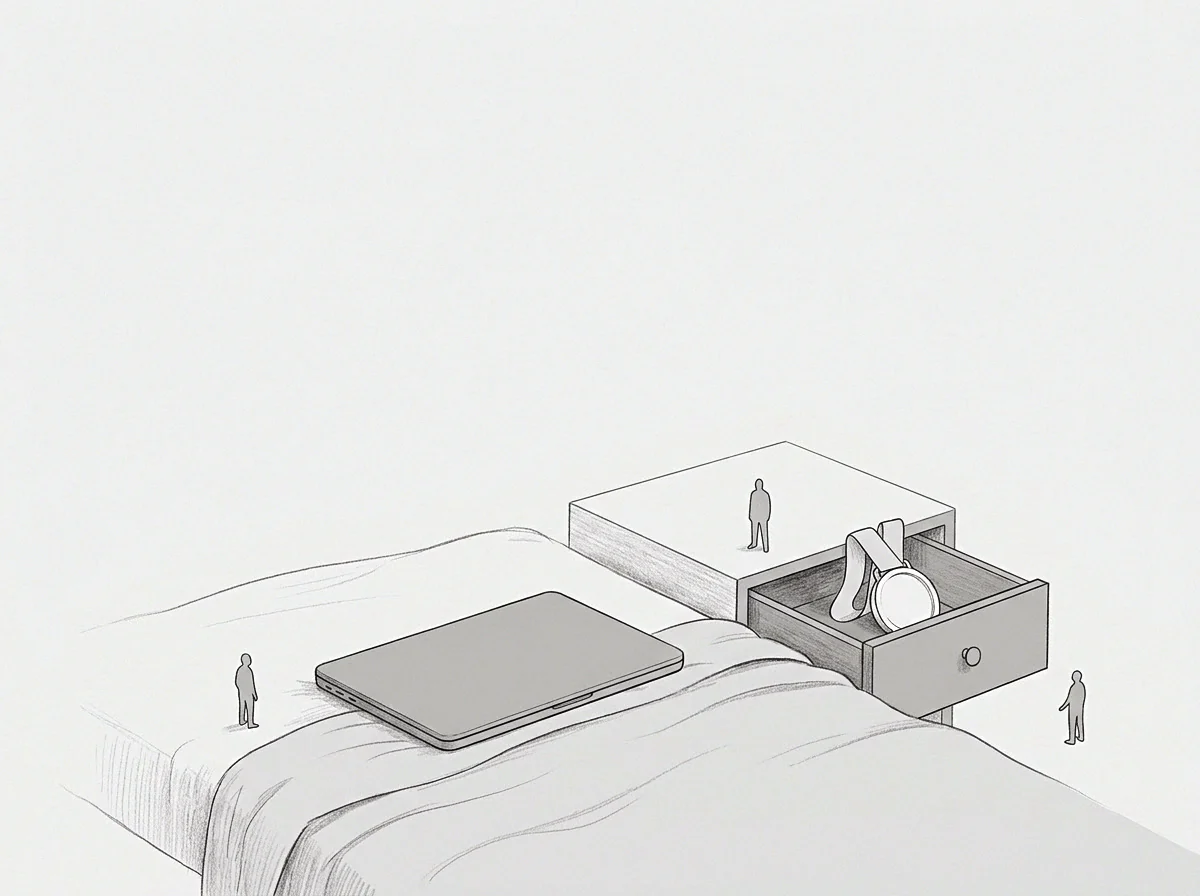
Hardware custody carries direct evidentiary weight when establishing ownership boundaries. An engineer writing code on an employer-issued machine or pushing commits over corporate network infrastructure activates statutory provisions favoring company ownership, even if the software falls outside the firm’s commercial scope. The home-office desk, a personal laptop sitting next to a company laptop, and shared cloud folders become primary focal points in exit forensics.
Take two colleagues who incorporate a data infrastructure firm with equal equity. The departing founder spends four hours every Sunday writing machine learning models for agricultural optimization, running them on a company laptop and pushing commits to a private account. At separation, the continuing partner inspects device backups and claims corporate ownership of the agricultural models under the equipment clauses in the corporate charter.
The physical device anchors the legal claim.
Corporate equipment utilization overrides personal time assertions in statutory ownership disputes.
Forensic reviews of storage drives, browser caches, and terminal histories often uncover overlap between personal projects and company operations. Pasting code across local terminal windows creates commingled files that mix open-source utilities, proprietary company routines, and personal tools. Untangling that code during an exit requires line-by-line auditing that consumes weeks of engineering attention.
Files placed in local directories become company property once they sync to the enterprise cloud backup.
Scope

Carveouts, Trade Secrets, and Residual Knowledge
Separation agreements address intellectual property deltas through several specific instruments: retroactive assignment ratifications, explicit carveout schedules, patent covenants, and residual knowledge clauses. Each mechanism divides the work product into enterprise property and retained individual capital. Ambiguity in these definitions exposes subsequent ventures to ongoing legal risk.
A residual knowledge clause protects the departing specialist by allowing the retention of generalized ideas, concepts, and techniques stored in unaided memory. It covers unwritten professional skill while prohibiting the deliberate memorization of confidential source files or proprietary client data. The boundary depends on documentation and the level of implementation detail.
The parties typically encounter intense friction across three specific contractual boundaries:
- Excluded Asset Schedule enumerating specific pre-existing repositories, patents, and written manuscripts with technological precision to prevent corporate absorption.
- Residual Information Term protecting general techniques retained in unaided human memory while excluding tangible source files, proprietary databases, and internal trade secret documentation.
- Non-Assertion Covenant barring the departing party from asserting patents against continuing enterprise operations while retaining personal ownership of the underlying patent portfolio.
Unaided human memory defines the perimeter of permissible residual knowledge.
Legal counsel split on whether broad non-assertion covenants offer enough security for future investors. One position holds that only an absolute assignment provides clean commercial title; another maintains that a perpetual, royalty-free, exclusive license offers the same operational protection without stripping individual inventorship credit. The distinction becomes critical when financing rounds call for formal legal opinions on chain of title.
Attaching a formal carveout schedule with cryptographic hashes of excluded repositories sets clear boundaries between pre-existing personal assets and acquired company property.
Carveout

The Architecture of Clean Separation
Carrying out an orderly intellectual property release requires reconciling personal skill with corporate title. The departing party presents an itemized list of claims; the company checks that list against repository logs and disclosure records. Where discrepancies appear, the separation agreement needs to assign or release each contested asset individually rather than relying on a general release.
A standard mutual release extinguishes existing claims of liability between parties, but it does not convey legal title to intellectual property. An unassigned asset remains unassigned after an ordinary severance agreement is signed. A clean separation requires affirmative assignment schedules alongside quitclaim deeds for disputed assets, ensuring that even if an assignment fails on a statutory technicality, the contributor relinquishes the right to bring infringement claims against future operations.
A departing founder loses leverage by signing broad release papers before obtaining written confirmation of retained personal property. At the same time, the company introduces risk to its capitalization table if it releases severance funds before verifying that all code repositories, administrative credentials, and patent assignments have been signed and delivered. Precise separation schedules replace personal assumptions with verifiable terms.
Detailed schedules signed at departure outlast confident spoken recollections of ownership.