
Parol Evidence Exclusions When Spoken Audio Meets Written Integration Clauses
Parol evidence rules exclude prior spoken audio recordings from altering a fully integrated written contract regardless of the recording fidelity.

Voice
Digital recording devices preserve spoken statements with absolute fidelity. Legal doctrine evaluates those same statements through the strict boundary of written integration clauses. Audio records sound.
When contracting parties negotiate terms verbally, a high-definition audio file captures tone, pauses, and exact phrasing without the reconstructive decay that alters human memory across time. A partner who records a two-hour planning session holds a perfect historical record of what was said in that room. The contract system, however, operates on a different rule of decision.

Audio Capture and Legal Integration
The parol evidence rule acts as a substantive barrier rather than a procedural evidentiary test. It governs whether prior oral negotiations possess any legal existence once a final written agreement is executed. Litigants frequently assume that an audio recording bypasses parol evidence exclusions because the recording eliminates factual disputes about whether the words were spoken.
The rule does not exist to resolve factual disputes about memory. The rule establishes the finality of written intent.
An audio recording of prior negotiations loses all legal effect once parties execute a fully integrated written agreement covering the same subject matter.
If two founders discuss a revenue split over a recorded call and later sign an agreement containing a complete merger clause, the written term replaces the spoken sound. High-fidelity audio demonstrates what was discussed during negotiations, yet the signed paper determines what was agreed upon at execution. Silence alters obligations.
Relying on pre-execution audio notes to alter signed contract terms forces an operator to bear the unrecoverable expenses of doomed litigation.

Merger
Integration clauses establish that a final written document contains the complete and exclusive agreement between contracting parties. The presence of a merger clause signals to a court that all prior conversations, written notes, and preliminary drafts are extinguished. Paper fixes terms.
Memory shifts across months. Integration clauses sever history.

The Four Corners Rule
Courts restrict contractual interpretation strictly to the text appearing inside the document limits. When a contract is fully integrated, extrinsic evidence cannot be introduced to contradict, add to, or modify the written terms. This exclusion applies to digital audio files with the same force it applies to unrecorded verbal claims.
The contract governs.
Take two founders who recorded eight hours of negotiation calls detailing a promised product revenue share of thirty percent. Assume the counterparty later signed a written agreement specifying a twenty percent share alongside an explicit integration provision. When a dispute arises, the founder who held the audio file expected the recording to override the text.
The judicial analysis stops at the written text. The prior audio recording remains excluded under substantive law regardless of its pristine acoustic clarity.
- Pre-Contractual Audio Recording captures verbal promises and preliminary pricing models during initial discussions between commercial parties.
- Execution of Written Agreement introduces an explicit merger provision that extinguishes prior oral representations made before signing.
- Judicial Exclusion Determination bars the introduction of recorded audio files during breach of contract litigation under the parol evidence rule.
| Media Type | Evidentiary Claim | Substantive PER Barrier | Admissibility Outcome |
|---|---|---|---|
| Unrecorded Oral Statement | Memory of spoken promise | Excluded by merger clause | Inadmissible to alter terms |
| Digital Voice Recording | Exact audio proof of promise | Excluded by merger clause | Inadmissible to alter terms |
| Pre-Contract Draft Email | Written record of negotiation | Excluded by merger clause | Inadmissible to alter terms |
| Signed Written Addendum | Executed post-contract modification | Bypasses prior merger clause | Admissible as new term |
The insertion of a standard integration clause converts all prior spoken promises into legally non-existent background noise.
Paper
Written text functions as a definitive legal boundary that displaces prior spoken conversations. Legal systems favor written agreements because written text represents a deliberate, calculated moment of mutual consent. Spoken dialog flows fluidly, accommodating hypothetical statements, temporary concessions, and unformed ideas that neither party intends to lock into an enforceable obligation.

Substantive Law Over Evidentiary Weight
Litigants often mistake high audio quality for automatic legal admissibility. The distinction lies between evidence that proves a statement was made and law that defines whether the statement carries legal weight. The parol evidence rule is a rule of substantive contract law.
It specifies that once parties adopt a writing as their integrated agreement, prior statements fall outside the enforceable contract boundary entirely.
A merger clause operates as an intentional wiping of prior verbal commitments regardless of audio clarity.
Written terms override recordings. Proof demands signed text. When a party presents a clear audio recording of a promise omitted from the signed agreement, the court does not reject the file because it doubts the audio authenticity.
The court rejects the file because the substantive law dictates that the signed writing superseded all earlier expressions of intent. The signed contract reflects the final agreement, rendering any earlier spoken conversation irrelevant.

Fraud
Deceptive inducements open a specific narrow path through integration barriers. While the parol evidence rule strictly excludes prior oral terms that contradict a written contract, it does not block evidence offered to show that the contract itself was procured through illegal or deceptive acts.
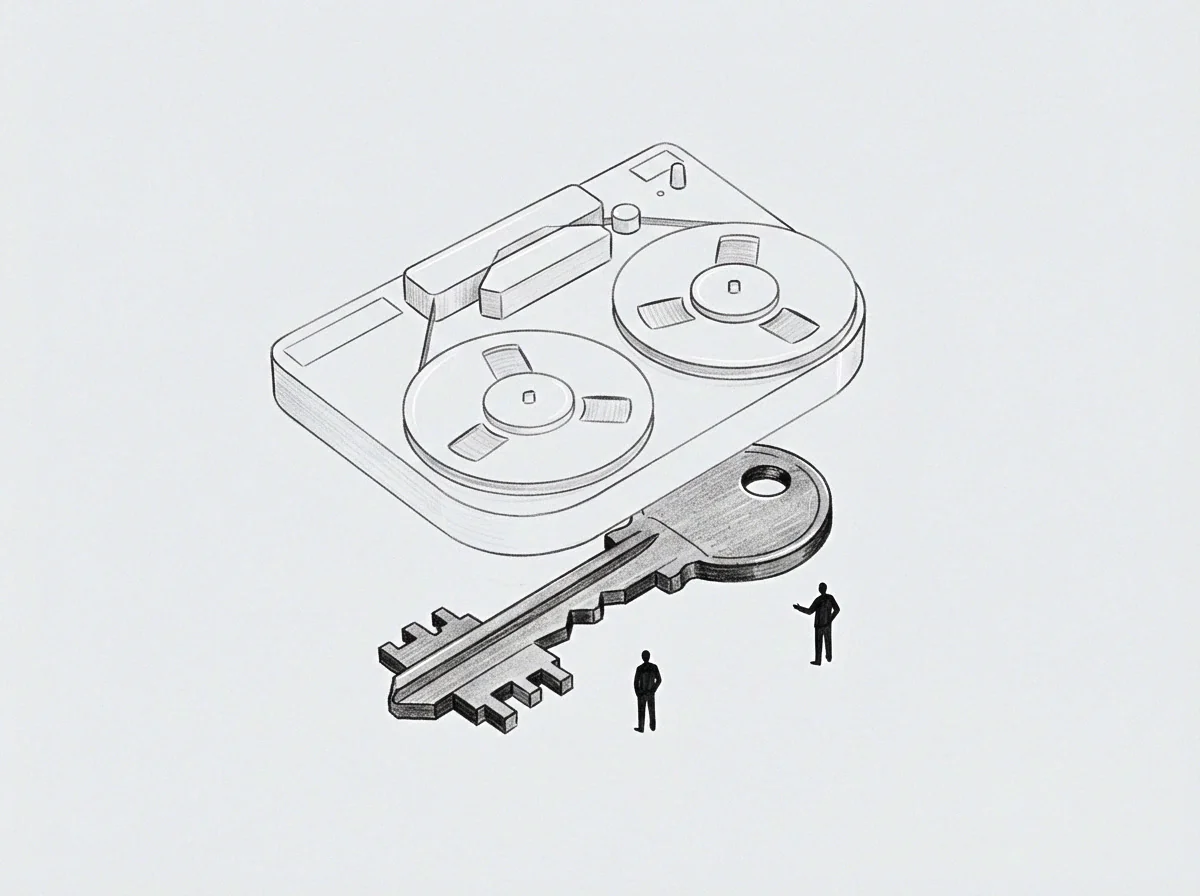
Which Audio Evidence Pierces an Integration Clause?
Spoken recordings become admissible when demonstrating that one party intentionally misrepresented facts to secure a signature. High fidelity changes nothing. Ambiguity opens the door.
If a seller verbally asserts on a voice recording that a company possesses five active patents while knowing the applications were rejected, and the buyer signs an integrated acquisition agreement relying on that assertion, the audio file enters evidence to prove fraud in the inducement.
Audio evidence invalidates an integrated contract only when it proves intentional deceit rather than a conflicting promise.
Audio recordings also gain entry when a written term contains genuine structural ambiguity. If an integrated clause states that payment depends on standard operating metrics without defining those metrics, recorded negotiation calls may be admitted solely to clarify what the parties meant by the ambiguous phrase. The audio cannot add a new obligation.
It serves only to decode the obscure text already present on the page. Courts continue to debate whether post-execution spoken audio messages constitute oral modifications or inadmissible parol statements when written contracts contain strict non-waiver clauses.

File
Documentary governance systems secure verbal commitments by converting spoken audio into written addenda prior to signature execution. Relying on stored voice notes to safeguard business terms creates a false sense of security. Intent governs contract enforceability.
Exclusions block prior assurances. Silence alters obligations.

Operational Handover Protocols
Operators manage contract risk by establishing clear workflows between negotiation audio and final contract text. When key commercial terms surface during audio calls, those terms must be transposed into explicit contract provisions before execution occurs.
- Transcript Extraction converts key audio statements into exact text snippets during contract drafting phases.
- Express Incorporation references specific recorded discussions directly within written contract schedules.
- Explicit Amendment Drafting attaches revised terms as signed addenda whenever spoken understandings shift post-signature.
- Centralized Record Archiving stores final signed contracts alongside verified audit trails of all formal modifications.
An unwritten spoken promise remains unenforceable no matter how clearly recorded on digital audio media.
The discipline of contractual documentation requires that no verbal understanding remains unwritten. When an operator leaves a spoken commitment out of the integrated contract, the protection of the written document works against them. Any spoken promise left outside the written agreement is a promise lost to the integration clause.